Track Record · The work behind the decision
Examine the work.
Then ask the questions.
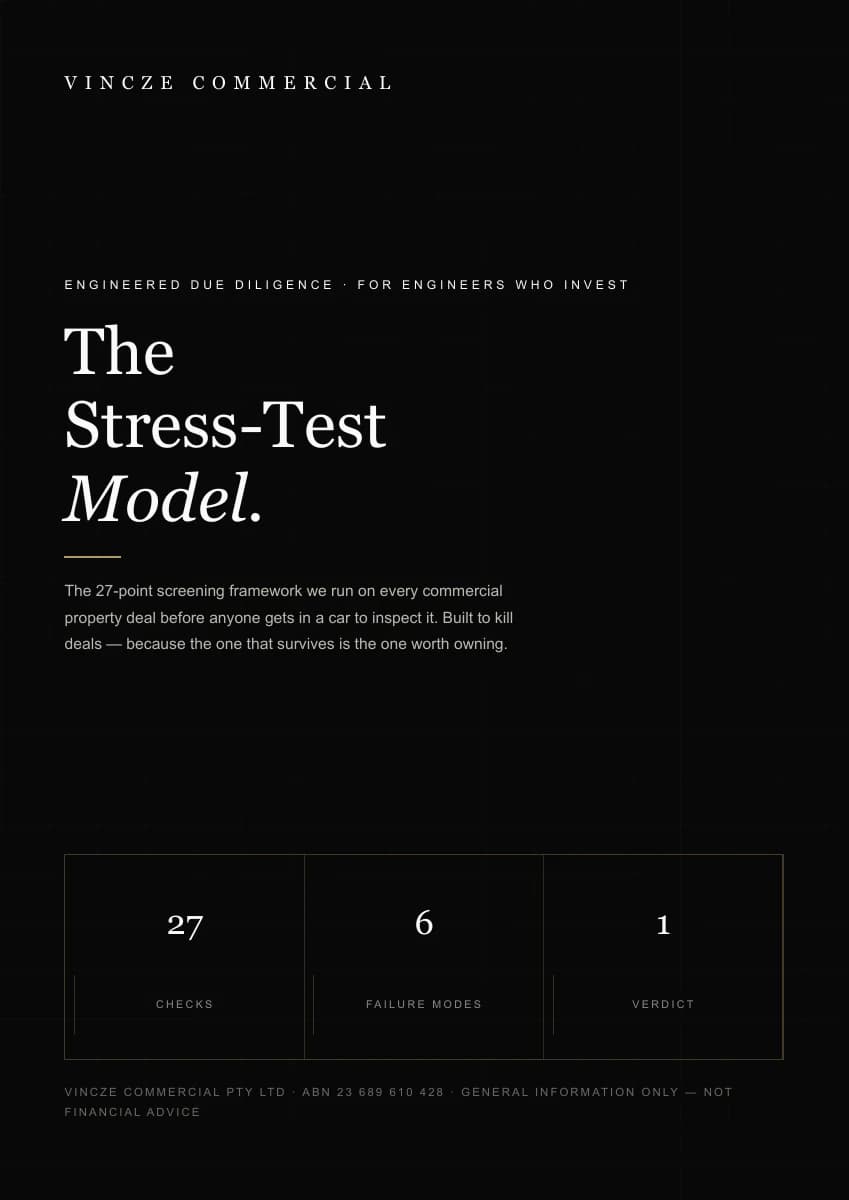
A headline figure is a starting point. Our published Stress-Test Model makes the screening approach tangible: 27 checks, six failure modes and a companion calculator you can examine for yourself.
Get the model and calculatorComplete the engineer briefing request to access both downloads.
Firm experience · in context
- Client portfolio value
- $100M+
- Off-market transactions
- 98%
- Years of practice
- 14+
These firm-reported figures describe experience. They are not a return forecast. Relevance depends on the mandate, asset and period; discuss that context with us when assessing your own brief.
Published methodology · pages 3–8
Six ways to
test the brief.
The guide sets out a pass criterion and a walk-away threshold for each check. A check that cannot be verified has not passed. The calculator supports five quantitative checks; the other 22 require documentary review.
Source: Stress-Test Model, pages 2–9; companion calculator, Verdict sheet. This is a summary of the framework, not a client case study.
- 01
Tenant covenant
Checks 01–05 · p. 03
Financials, revenue concentration, security and the rental ledger establish who stands behind the income.
- 02
Lease expiry
Checks 06–09 · p. 04
Firm lease terms, expiry concentration and break clauses are considered against the intended hold period.
- 03
Outgoings recovery
Checks 10–14 · p. 05
Recovery schedules, statutory notices, capital expenditure and insurance are checked against documents.
- 04
Rate sensitivity
Checks 15–18 · p. 06
Interest cover at a higher debt cost, refinancing dates and covenant headroom test the financing assumptions.
- 05
Vacancy load
Checks 19–23 · p. 07
Six months without rent, re-letting incentives and a liquid buffer turn vacancy into a defined cost.
- 06
Exit liquidity
Checks 24–27 · p. 08
Buyer depth, a softer exit yield, title and planning help test the path back out of the asset.
Inside the calculator · illustrative inputs
Make the stress
visible in dollars.
The workbook includes an educational example: a $2.2M purchase, $180,000 annual net passing income, 60% borrowing and a 6.2% interest rate. It is not a completed transaction or a promised result.
Here is what two of its calculations reveal. Replace the example inputs with your own, then verify the underlying documents.
Interest cover at 8.2% · a +200 bp stress
1.66×
$180,000 income ÷ $108,240 annual interest. This tests interest cover alone; it does not establish that all 27 checks pass.
Six-month vacancy carry · at the original rate
$108,420
$22,500 outgoings + $40,920 interest + $45,000 re-letting incentive. Against the example’s $150,000 liquid buffer, coverage is 1.38×.
Source: companion calculator, Inputs and Stress Cases sheets. Rounded cover ratios. Interest-only calculations; general information, with independent professional advice required before acting.
Your next step
Bring a brief.
Ask for the working.
Client-specific evidence requires permission and confidentiality. Ask which material can be shared for a mandate like yours, including the assumptions, checks and decisions behind it.